"But you shall receive power when the Holy Spirit has come upon you; and you shall be witnesses to Me.”
(Acts 1:8)
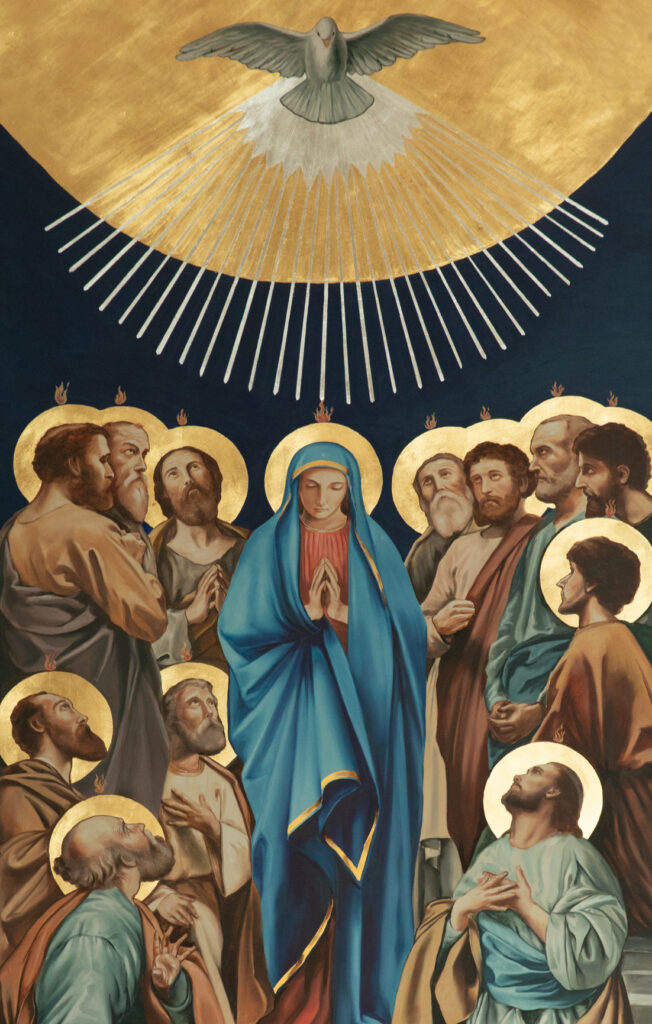
Icon of The Pentecost Painted at St. Mary & St. Joseph Coptic Orthodox Church
The Story In A Minute
00:00
00:00
Pentecost Meaning
The word Pentecost is borrowed from the Greek name of the Jewish festival Shavuot. Shavuot is a Hebrew word which simply means “weeks” and so it signifies the Festival of Weeks mentioned in the Old Testament. It is one of the three major Jewish pilgrimage festivals which holds two important meanings to the Jews: 1) it marks the wheat harvest in Israel as mentioned in Exodus 34:22, and 2) it commemorates the anniversary of the day when God gave the law and the commandments to Moses and the people of Israel. This Jewish feast is held 50 days after Passover of the Jews, and so it was called Pentecost by the Hellenic Greek community – simply meaning “fiftieth day”.
Early Church Tradition
The Early Church held on to this tradition of calling it Pentecost because 50 days after the Great Christian Passover – the crucifixion and resurrection of the Lord Jesus Christ – we see that the Lord now grants humanity a new gift, different from that which was given to Moses. While in the old testament humanity receives the law written on tablets of stone, in the New Testament the apostles and humanity now receive the indwelling Holy Spirit, the Life-giver and Comforter which was promised to us by the Lord.
The Significance of Pentecost
In the book of Acts, we hear about how the apostles of the Lord along with the Holy Virgin Mary gathered together in prayer 50 days after the Passover. Saint Luke describes to us the following event:
“When the Day of Pentecost had fully come, they were all with one accord in one place. And suddenly there came a sound from heaven, as of a rushing mighty wind, and it filled the whole house where they were sitting. Then there appeared to them divided tongues, as of fire, and one sat upon each of them. And they were all filled with the Holy Spirit…” (Acts 2:1-4).
This was in fulfillment of the promise made by Jesus before His crucifixion:
The Counselor, the Holy Spirit, whom the Father will send in my name, he will teach you all things, and bring to your remembrance all that I have said to you" (John 14:26).
Saint Mark explicitly mentions the promise to enable them "to speak in new tongues" (Mark 16:17). These and similar pledges were all fulfilled ten days after the Ascension, that is, fifty days after the Resurrection, equivalent to the Jewish Feast of Weeks that occurred on the fiftieth day after the Passover (Deuteronomy 16).
Joyful Fifty Days
The fifty days period after Resurrection is a great time of joy, and there are no fasts or prostrations. This period is a time of praising our Savior, enjoying our restoration to Him, and growing in our relationship with Him. We journey through this joyful season with Sunday Gospel readings deepening our understanding of our Lord in His Glory: 1. My Lord and my God - Thomas Sunday 2. The Bread of Life 3. The Living Water 4. The Light of the World 5. The Way, the Truth, and the Life 6. The King of Peace 7. The Comforter
Importance of the Feast
The Coptic Orthodox church celebrates 7 Major Feasts every year. The Pentecost is one of them. The other 6 major feasts are: The Annunciation, Nativity, Epiphany, Palm Sunday, Resurrection, and the Ascension. The feast of Pentecost is very important because it is the feast of the Holy Spirit. As Christ ascended into heaven He tells His disciples not to fear because He will send down the Holy Spirit as their Comforter. Thus, the Holy Spirit descended on the holy and pure apostles in the form of tongues of fire. Pentecost is considered the day that the Church was established. On this day we are filled with the Holy Spirit, Who guides us, supports us, purifies us, and gives us strength. It is with the power of the Holy Spirit, that the disciples were able to go throughout the earth and bring the people to Him. Likewise, it is with the Holy Spirit that we too are given strength to continue renewing our spiritual lives and serve everyone in the world around us.
Spiritual Application from the Orthodox Creed
While we celebrate Pentecost as a historical event in the life of the Church, we also celebrate it as a daily reminder of
the Holy Spirit, Whom we have living and working within us. God within us. To the Christian, the celebration of Pentecost is one where we declare that we have faith that God now works with us, through us, and dwells within us. In our daily prayer in the Orthodox Creed we say: "We believe in the Holy Spirit, the Lord, the Giver of Life, Who proceeds from the Father, Who with the Father and the Son, is worshipped and glorified, Who spoke by the prophets."
The Feast
The church celebrates the commemoration of the Feast of Pentecost on Sunday after fifty days of the Glorious Feast of Resurrection every year.